

You’re probably not surprised that, even in the military, many people spend much of the day sitting—whether it’s in a vehicle or cockpit, at a desk, or on the couch at home. What might come as a surprise though, is even if you exercise regularly, prolonged sedentary behavior can still have negative effects on your health and performance. Long periods of sitting are linked to increased risks of heart disease, insulin resistance, and weight gain, and decreased metabolic function. Even for people who are highly active, spending most of the day seated can be bad for your health.
Physical inactivity and sedentary behavior are now viewed as separate entities on a continuum of human movement. In the military, participating in PT and other personal exercise routines can allow you to regularly meet the U.S. Department of Health and Human Services’ Physical Activity Guidelines, which recommend a minimum of 150 min/week of moderate to vigorous physical activity, or 75 min/week of vigorous physical activity. But you can be both physically active and highly sedentary at the same time. Paying attention to both physical activity and sedentary behavior are important for health, performance, and readiness, since exercise only partially counteracts the negative health effects of highly sedentary behavior. Reducing your sedentary behavior can lead to health benefits such as improvements in body weight, waist circumference, percent of body fat, and blood pressure.
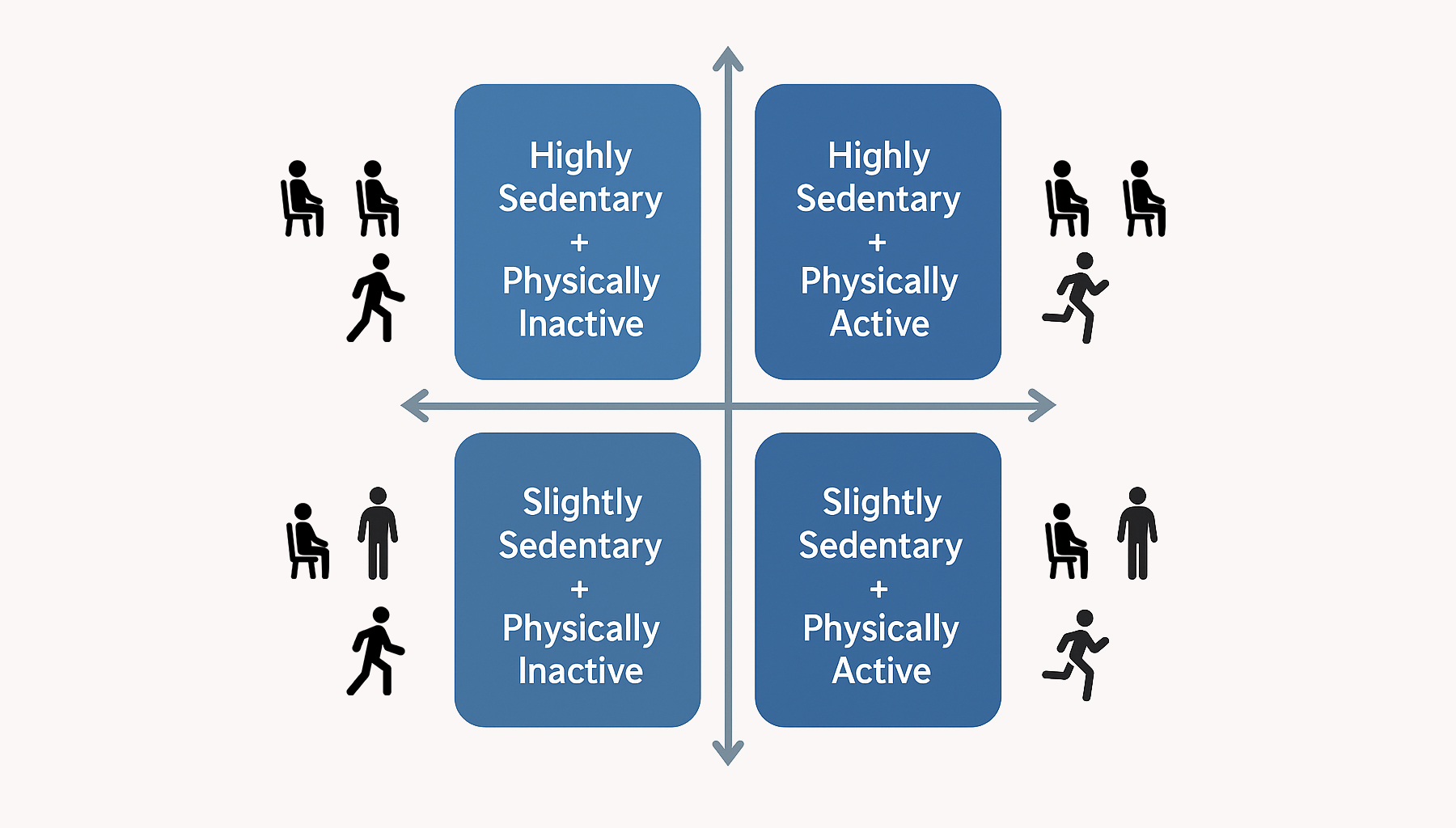
- Sedentary behavior refers to any waking action done while sitting, reclined, or lying down, where energy spent (or effort) is similar to energy spent when resting or sitting still.
- Physical inactivity refers to a lack of physical activity in someone’s lifestyle, but more specifically, not meeting physical activity guidelines.
- Physical activity is any movement that increases your energy expenditure (the amount of calories your body uses), ranging from daily tasks to intentional exercise at any intensity.
- Exercise is any planned, structured, repetitive, and purposeful physical activity done to build or maintain fitness.
- Non-exercise activity refers to everyday activities that happen as a by-product of other tasks, without specific fitness or sport goals, such as taking the stairs, walking the dog, dancing, gardening, or doing chores.
There are distinct benefits to regular exercise, and regular non-exercise activity. Ideally, both are included in your day. Exercise can help you meet the physical activity guidelines, and non-exercise activity can help you break up sedentary behavior. To get you started, here are 5 ways you can break up sedentary behavior throughout the day.
Published on: November 7, 2025


Parshuram, G.A., Tuira, L., Dazo, F., El Hariri, N., Hulst, J.M., & Mtaweh, H. (2024). Components of total energy expenditure in healthy and critically ill children: A comprehensive review. Nutrients. 16(16):2581. https://doi.org/10.3390/nu16162581
Pedišić, Ž. (2014). Measurement issues and poor adjustments for physical activity and sleep undermine sedentary behaviour research—the focus should shift to the balance between sleep, sedentary behaviour, standing and activity. Kinesiology, 46 (1), 135–146. https://hrcak.srce.hr/123743
Pinto, A.J., Bergouignan, A., Dempsey, P.C., Roschel, H., Owen, N., Gualano, B., & Dunstan, D.W. (2023). Physiology of sedentary behavior. Physiological Reviews, 103(4), 2561–2622. https://doi.org/10.1152/physrev.00022.2022
Reyes-Molina, D., Zapata-Lamana, R., Nazar, G., Cigarroa, I., Ruiz, J.R., Parrado, E., Losilla, J.M., & Celis-Morales, C. (2025). Conceptual and evidence update on incidental physical activity: A scoping review of experimental and observational studies. Scandinavian Journal of Medicine in Science & Sports, 35(1):e70015. https://doi.org/10.1111/sms.70015
Tremblay, M.S., Aubert, S., Barnes, J D., Saunders, T.J., Carson, V., Latimer-Cheung, A.E., Chastin, S.F.M., Altenburg, T.M., & Chinapaw, M.J.M. (2017). Sedentary Behavior Research Network (SBRN)—Terminology Consensus Project process and outcome. The International Journal of Behavioral Nutrition and Physical Activity, 14(1), 75. https://doi.org/10.1186/s12966-017-0525-8
Wang, T., Laher, I., & Li, S. (2024). Exercise snacks and physical fitness in sedentary populations. Sports Medicine and Health Science, 7(1), 1–7. https://doi.org/10.1016/j.smhs.2024.02.006
World Health Organization. (2020). WHO guidelines on physical activity and sedentary behaviour. World Health Organization. https://iris.who.int/bitstream/handle/10665/336656/9789240015128-eng.pdf