



Your beliefs—both conscious and unconscious—shape every decision you make. When your health and performance beliefs are accurate and productive, the choices you make can boost your health, wellness, and performance. But when they’re off, they can drive you toward choices that backfire. In some situations, being wrong carries real consequences.
For example, beliefs can change certain bodily responses to stress. The goal of stress for your body is to mobilize energy and sharpen cognitive and physical performance. Your heart rate and breathing increase, your muscles become tense, and your pupils dilate. Some people believe that experiencing these bodily sensations of stress is always harmful, which is not the case. If you believe stress is helping you, your blood vessels relax, and your increased heart rate mimics the benefits of exercise. But if you think stress is always harmful, the increase in heart rate will constrict your blood vessels, potentially leading to heart damage.
In this case, believing stress is bad has become a self-fulfilling prophecy. In addition, when you believe stress is bad, feeling these stress-induced changes in your body could increase anxiety, degrade your performance under pressure, and take a negative toll on your health.
When you challenge the assumption that stress is always bad and build a productive stress mindset, you learn to channel the energy from your body’s stress response system to meet high-stakes demands. Therefore, making sure your beliefs are accurate and productive is key to performance.
Fact-based beliefs can help you perform better and stay prepared. But if you don’t check your assumptions, they can lead you to make choices that work against your goals.
You can be intentional about checking and challenging your assumptions. This is a long, challenging process. But engaging in it can help you realize what others might be seeing that you’re missing, become less reactive to news and social media, and be better prepared to make informed decisions. The 10 steps below will guide you through that process.
Confirmation Bias: What It Is and Why It Is Hard to See
Confirmation bias is the natural tendency to pay more attention to things that validate your beliefs. And here’s why it happens.
Your brain can use two types of thinking: slow, careful analysis and fast, “gut feeling” thinking. Slow offers precision, but it costs time and mental energy you don’t have when you are under pressure or short on information. Fast thinking uses mental shortcuts to fill in missing details and prevent overanalyzing to help you make decisions quickly. But it’s not foolproof.
This fast thinking fuels confirmation bias, where your brain filters new details through what you already believe. While that can help you build a strong case, it can also narrow your view, hide important facts, and lead you to ignore warning signs and steer you toward bad choices.
Confirmation bias affects everyone and is not a sign of weakness. Because it happens without you noticing, it feels like you're simply seeing what's there. Here is what your brain is actually doing:
- Noticing: Your brain lets in evidence that fits what you already believe and filters out most of what doesn't. You don't experience this as filtering. You experience it as reality.
- Interpreting: When information is ambiguous and could be explained in multiple ways, your brain settles on the reading that fits the story you already believe.
- Remembering: You easily recall facts that support your views while forgetting data that challenges them.
- Weighing: If evidence that contradicts your assumptions survives all of the previous steps, your brain discounts it as the exception to the rule so the belief stays intact.
Your daily environment can make it hard to challenge confirmation bias.
- Information overload: With too much data to process, you naturally filter out unfamiliar, uncomfortable information.
- Algorithms: Social media feeds are built to show you more of the content you tend to read and interact with to keep you scrolling.
- Social norms: The unwritten rules of your social group can make it hard to speak up and challenge what others already accept as true.
- Time pressure and fatigue: The exhaustion of a demanding operational tempo leaves you with barely any mental or cognitive energy to question your own thinking.
Checking your beliefs requires intentional and deliberate work. Your brain is wired to be fast, not accurate. To help you survive, your brain evolved to connect the dots quickly and make decisions based on existing information so you can act without hesitation.
In high-pressure situations, quick decisions can help you perform well. But if you use this fast thinking for everyday choices, you might miss important details. If you don’t take time to question your beliefs and assumptions, you could end up with a distorted view that harms your relationships, performance, and readiness—just like with the example that stress is always harmful.
Being open to different viewpoints is a good first step, but it’s not enough. To really challenge bias, you need to actively identify, think through, and share your thought process. Move through the 4 following phases—Be Aware, Explore, Identify, and Strategize—at your pace, embracing the process and the things you learn along the way.
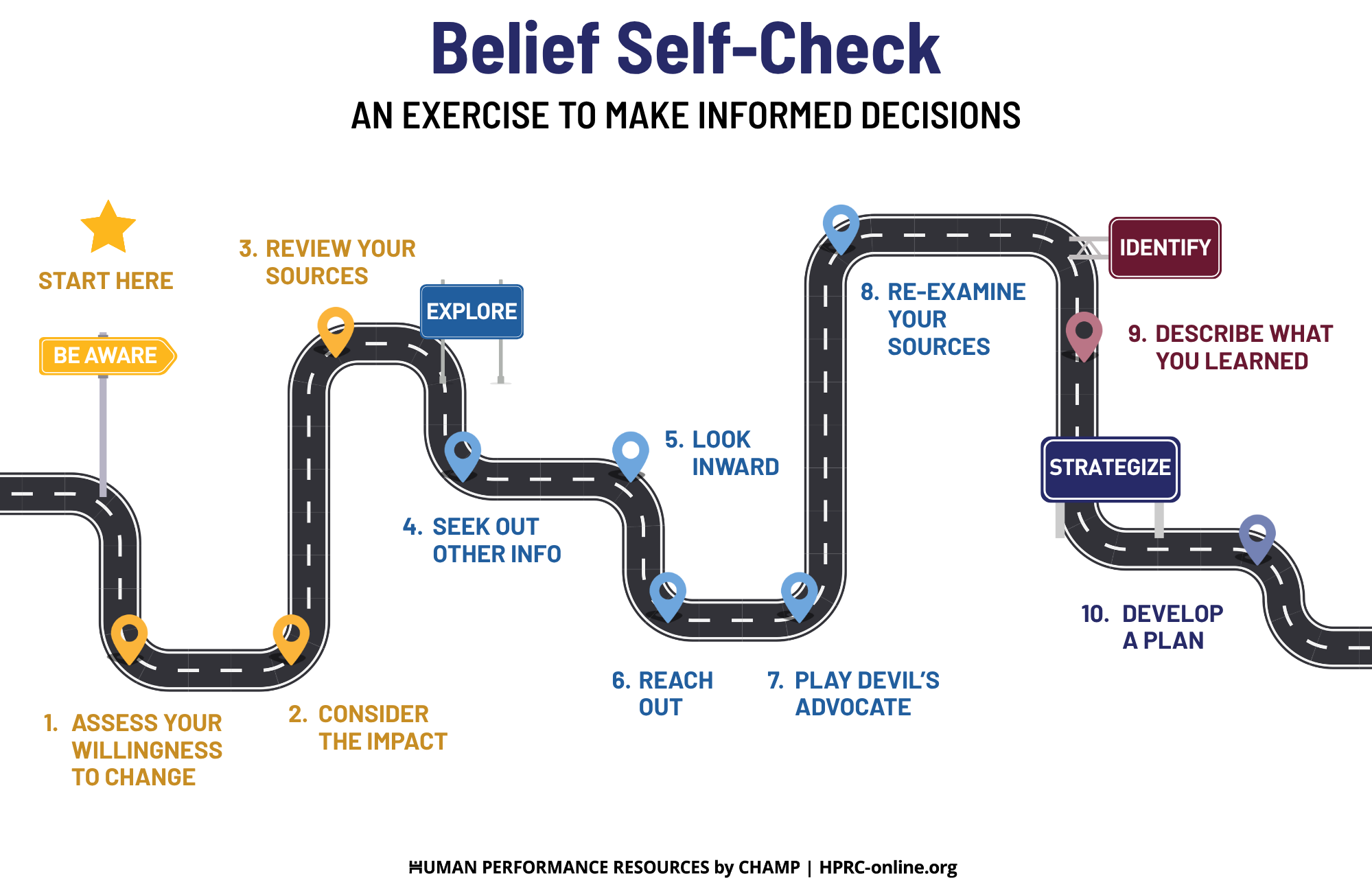
Phase 1: Activate Awareness
Goal: To identify your belief and its effects before trying to change anything.
Step 1: Pinpoint your belief and assess your willingness to change. Write your belief in a single sentence. If it can’t be stated clearly, it can’t be examined. Writing it out forces you to be specific, and it can help you identify a belief you didn’t even know was there. Create a claim as specifically as possible.
- Vague claim: “Stress is always bad for me.”
- Specific claim: “The physical symptoms of stress, like a racing heart, will cause me to panic and perform poorly.”
Next, reflect and rate your willingness to change. On a scale of 1 (not willing at all) to 10 (very willing), higher numbers mean you are more open to re-evaluating a belief, and lower numbers mean you are more fixed on it. Any number is okay. The idea is just to be aware of your belief and how tightly you hold it.
Step 2: Consider its effect. Beliefs don’t exist in a vacuum. They are built on pre-existing assumptions and influence the choices you make every day. When you understand the roots and ripple effects of your beliefs, you can prioritize addressing the ones most likely to affect your health, wellness, and performance. Some questions you can ask yourself include:
- What other beliefs led to this one?
- What other assumptions are based on this belief?
- What specific decisions or actions have you already taken because you believe this to be true?
- Is this a low-cost belief, or is it a high-cost belief? What harm could happen if you are wrong about this belief?
- How is this belief shaping your health, performance, relationships, and overall readiness?
Step 3. Review your sources. Trace your belief back to its source of information. This step helps you differentiate factual information from noise or uninformed opinions.
- Did you form this belief through direct experience, or is it based on secondhand input?
- How much of this belief is driven by outside influences like your social circle, the news cycle, social media, marketing, or your immediate environment?
- Is the original source of this information truly reliable? (You will apply a formal credibility check to this in Step 8).
Phase 2: Explore
Goal: To seek and engage with information that challenges your belief.
Step 4: Seek out other information. You naturally gravitate toward information that validates your current mindset, which creates blind spots. Actively seeking out contradicting evidence disrupts this pattern and builds mental agility. Acknowledging that multiple interpretations might be valid is a crucial cognitive skill for mission success.
- When you think about where you get your information , what sources, viewpoints, or types of data have been completely absent?
- What specific evidence can you actively find that directly opposes your belief?
- What alternative viewpoints exist that might also be valid and worth considering?
- What exact evidence would it take to change your mind?"
Step 5: Look inward. Your physical and emotional states act as massive amplifiers for bias. Factors common in military life, like sleep loss, sustained operational stress, and high cognitive load, can narrow your attention and skew how you process information. Pausing to look inward helps you separate objective information from your current physical or emotional state.
- Are fatigue, stress, or strong emotions currently acting as bias amplifiers for you?
- How might your emotional state be skewing what information you notice and what you ignore?
- Can you accurately separate “what I feel” (intuition or gut reaction) from “what I know” (objective, verifiable facts)?
Step 6: Reach out. If you only talk about your beliefs with people who agree with you, those beliefs can be reinforced and get stronger. That’s why it’s important to find people who see things differently. Try to be curious instead of judgmental in these conversations. This helps keep the discussion open and avoids defensiveness, even when the topic is emotional. To make the conversation useful, ask open-ended questions and avoid ones that push your own view.
- Identify someone with a genuinely different perspective whom you can ask for input.
- When discussing the topic, ask: "What am I missing?"
- Ask: "How do you see this differently?"
Step 7: Play devil’s advocate. It’s easy to dismiss an opposing view if you only focus on its weak spots. Instead, try to make the best possible case for the other side. This helps you look at the facts more closely and notice any evidence you may have missed.
- How would you construct the strongest opposing case as if you genuinely believed it?
- What specific, valid evidence against your belief have you been minimizing or overlooking?
- What are three concrete pieces of evidence that support the opposing view?
Step 8: Re-examine your sources. People often trust familiar sources and unintentionally ignore others. Using a structured tool can help you check your sources and see if they are reliable. The HPRC Credibility Checklist is one way to make sure your beliefs are based on solid facts.
- What are your own filtering patterns? Which sources do you reject automatically, and which do you accept without scrutiny?
- When you run your main sources through the HPRC Credibility Checklist, what scores do they get?
- Are your trusted sources providing factual guidance, or are they simply validating what you want to hear?
Phase 3: Identify
Goal: To turn exploration into an updated view.
Step 9: Describe what you learned. Collecting new information is a great first step, but it isn’t enough. You need to reflect on it to see which beliefs have changed and which have stayed the same. When you do change your mind, putting your new belief into words gives you a clear place to start for taking action.
- Looking back at your exploration, what shifted, what held firm, and what is still uncertain?
- Beliefs don't have to completely flip to evolve. Are there any minor updates to your beliefs?
- If a change happened, how can you state your newly adjusted belief or behavior in a single specific claim?
Phase 4: Strategize
Goal: To turn your new insight into action.
Step 10: Develop a plan. Changing your belief is a big first step. Write out and say what has changed and why to make the new belief known. Next, it’s time to act on it. Make a clear plan to put your new belief into practice and see how it affects your readiness, performance, and relationships.
- How exactly are you going to move this new insight into tangible behavior change?
- In what specific ways in your daily routine will you test this adjusted belief?
- How can you use tools like the Mindset Portfolio or the "When-Then-Because" strategic habit framework to make this change stick?
Making It a Practice
“Debiasing” is a journey with waypoints, not something you achieve all at once. Change takes time, so you could remain in the same step for a long time. It’s okay if that happens. Give yourself room for it. Use this roadmap whenever you need to check in with yourself:
- Making high-stakes decisions
- Having strong emotional reactions to new information or opposing views
- Engaging in persistent disagreements
- Finding surprising health and performance outcomes when existing beliefs and practices fail to deliver expected outcomes
Keep coming back to your beliefs over time and practice being open to changing them as new information comes in. Belief systems are important for health, performance, and well-being, but holding onto them too tightly without regular examination can hinder growth.
Recognizing that an assumption may be wrong or incomplete shows strength, not weakness. Choose one belief, write it down, and use the roadmap to work through it.

